
People ask us what a home cinema costs more often than almost anything else. The honest answer is that it depends entirely on the outcome you’re after, because a $60,000 cinema and a $350,000 cinema are both correct answers to the same question. They’re just solving for different things.
There are three broad tiers we see in home cinema design, each shaped by a different set of priorities. None of them is the “right” one. The right one is whichever matches what the room needs to do and how the family is going to use it.que.
Family Cinema: $50,000–$150,000
This is the tier most families land in, and there’s nothing wrong with that. It won’t meet the higher benchmarks in CEDIA’s recommended practices for home cinema design, but it still delivers a genuinely great experience: a big screen, big sound, and a dedicated space for the family to actually use.
At this level, the choice between a projector and a large-format display is usually driven by budget and room layout rather than performance, and it’s worth understanding how projectors and big screens actually compare before settling on one. You’ll typically see a standard 16:9 screen without the lens memory or masking that lets the picture adjust cleanly between aspect ratios, and the projector, where one’s used, is usually mounted in clear view rather than concealed.
Audio calibration tends to be more basic. There’s no DSP amplification or spatial averaging in the calibration process, which means the sound you get in the best seat isn’t necessarily the sound you get in the others. Seat-to-seat variation is usually noticeable. Room acoustics are either not addressed at all or handled in a fairly basic way, the noise floor isn’t actively controlled, and lighting and room design generally aren’t treated as priorities.
None of that makes it a bad outcome. It makes it an entry-level outcome, and for a lot of families wanting a big-screen space to watch movies together, that’s exactly what they need.
High-Level Cinema: $150,000–$300,000
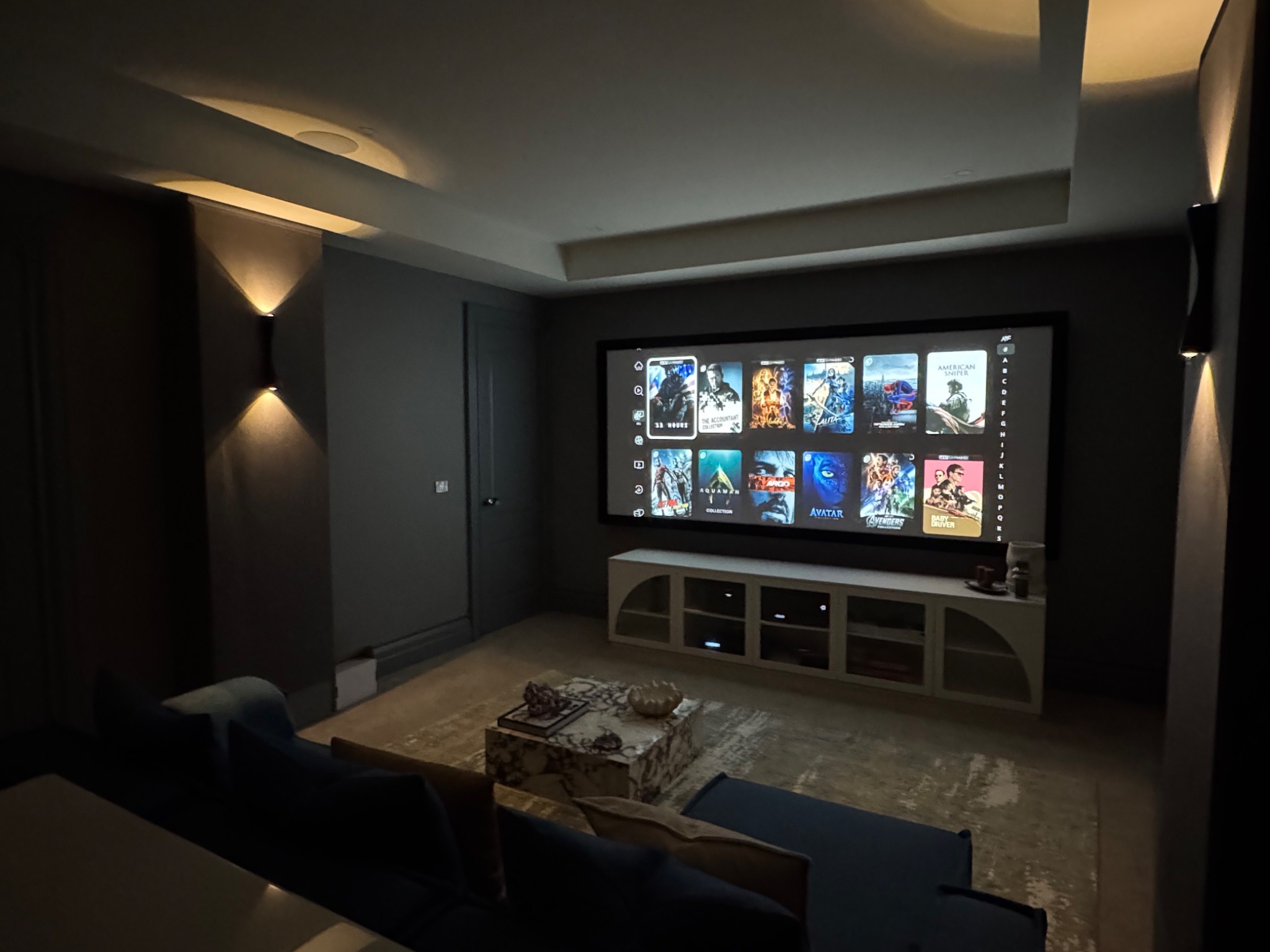
This is where the room starts doing real work, and where we start meeting the core benchmarks in CEDIA’s recommended practices for home cinema design. Done properly, a room at this level should outperform a commercial cinema, not just resemble one.
You’re looking at full Dolby Atmos with reference-level peaks in audio performance, and video calibration carried out properly enough to reproduce true imagery, including HDR10+. Power amplifiers run DSP with spatial averaging calibration, which is the difference between a system that sounds good in one seat and one that sounds good across the room. At this tier, seat-to-seat variation is held to around 3dB at most, which is a real, measurable standard, not a marketing line.
Acoustic treatment is generally concealed rather than left as visible panelling, lighting is considered as part of the design rather than added afterwards, and the noise floor is kept low. This is also roughly where the difference between soundproofing and acoustic treatment starts to matter, because the two solve different problems and a room built without understanding that distinction won’t perform the way it should.
Reference-Level Cinema: $300,000+
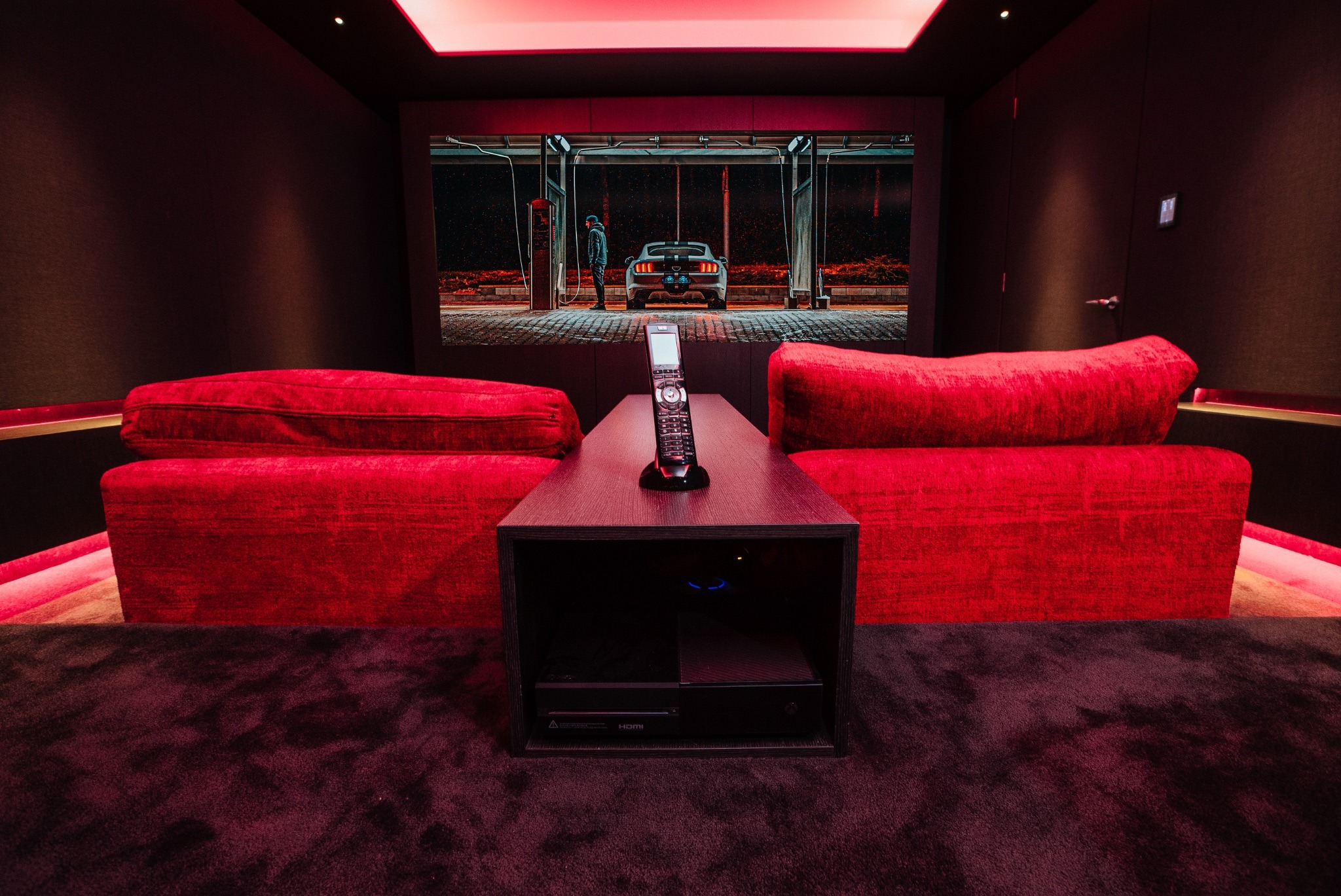
This is the top end of CEDIA’s recommended practices, levels 3 and 4, and it’s a genuinely different category of room. You’re not just watching a film. You’re hearing and seeing it the way the director intended, in a space engineered specifically to deliver that.
The noise floor in a reference room is typically very low. Projectors are often located outside the room entirely or housed in engineered enclosures, sometimes referred to as hush boxes, to keep mechanical noise out of the listening experience altogether. Screens commonly feature motorised masking, and the video system can reproduce every available aspect ratio cleanly rather than relying on black bars or manual adjustment.
Audio performance at this level exceeds 105dB at every seat, with variance between positions held to 1.5dB or less. That’s not a rounding difference from the high-level tier. It’s a different standard of engineering. Rooms at this tier sometimes include additions like infrasonic bass or interactive lighting, but those are extras layered on top of a room that’s already been engineered to a very deliberate result, not a substitute for that engineering.
What Actually Drives the Cost
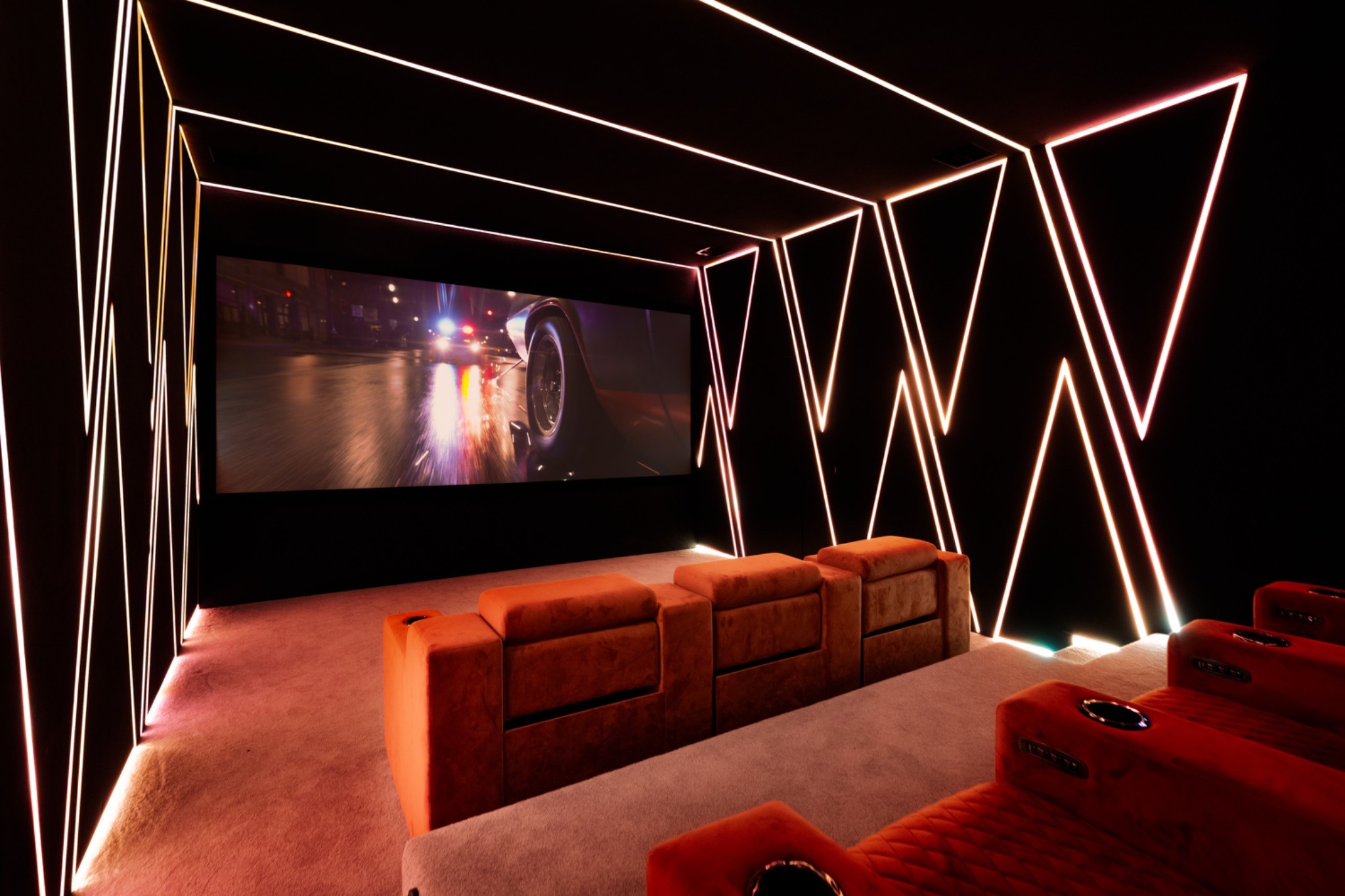
A few factors consistently move the number, regardless of which tier you’re building toward.
Room size and seating. A larger room needs more acoustic power to fill it properly, along with a bigger screen and projection system to match. More seats also means more channels, more furniture, and a build that scales accordingly.
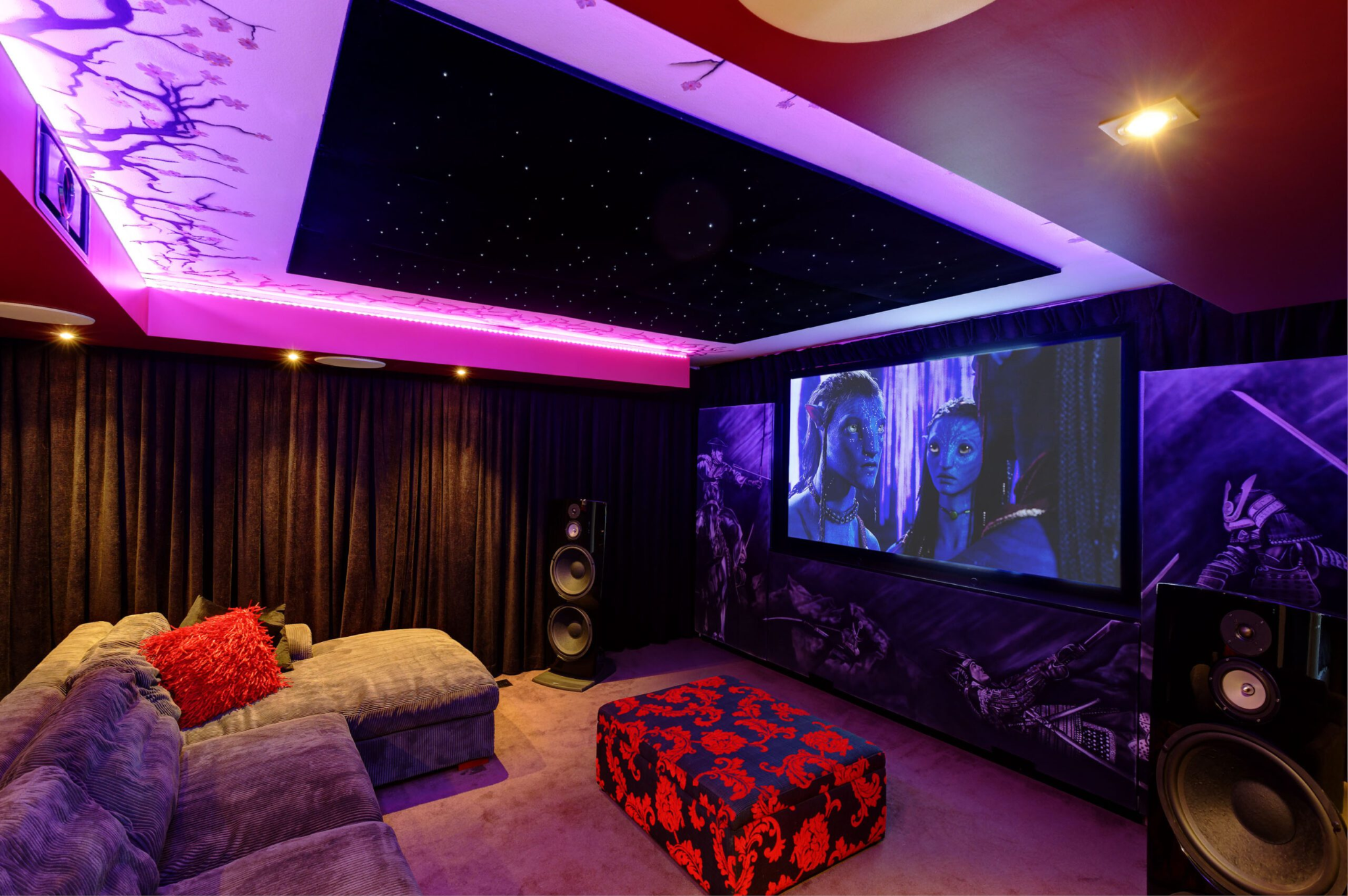
Interior design. Building a room to actually accommodate a cinema, baffle walls, internal treatment cavities, doors that seal acoustically, adds cost before you’ve touched a single piece of equipment. Custom-themed rooms with real intent behind the experience cost more again, and high-end finishes, leather, solid timber, designer detailing, push the number further still. We call these the one percenters internally: roughly one percent of additional gain for double the cost. They’re worth it for some clients and unnecessary for others, and that’s a conversation worth having early.
Soundproofing. A room designed to stop sound escaping or intruding takes considerably more engineering and material than one that isn’t, and the cost scales with how much isolation is actually required.
Specialised use. Gaming setups need low latency and tight audio-video sync, often with different brightness and aspect ratio requirements than film does. Live music needs a system built to handle live mixing without failure. Karaoke needs an audio system that can properly accept microphone input and stay in sync, which not every system is built to do. Multipurpose rooms, bars, wellness spaces, music practice rooms, dedicated hi-fi listening rooms, each carry their own specific requirements that can change the engineering and design from the ground up.
At Wired by MJD, we generally design around a 50/50 split between electronics and the room itself. If a client is investing $40,000 in equipment, we’d typically expect a similar investment going into seating, finishes, acoustics and lighting. The room and the equipment are part of the same outcome, and pricing them as though they’re separate rarely produces a good result.
Why We Don’t Sell Cinema Packages
You’ll see cinema packages advertised elsewhere, and it’s worth understanding what they actually are. A package is built to optimise return on an equipment purchase. It’s a way of bundling gear at a discount, not a way of designing a room around how a client actually lives and what they’re trying to achieve.
The underlying principles stay consistent across every tier we’ve described here. What changes, every time, is the room itself, the family using it and the outcome they’re after. That’s the part a package can’t account for, and it’s the part that actually determines whether a cinema delivers on its investment or just looks good on a spec sheet.
Frequently Asked Questions
How much does a home cinema cost in Australia?
A family-level home cinema typically starts from $50,000, a high-level cinema runs from $150,000 to $300,000, and a reference-level cinema engineered to the highest benchmarks starts from $300,000 and up. The right number depends on room size, the level of acoustic and interior treatment, and what the family actually wants from the space.
What are CEDIA’s recommended practices, and why do they matter?
CEDIA, the Custom Electronic Design and Installation Association, publishes recommended practices for how a home cinema should be designed and built to perform properly. There’s no such thing as a “CEDIA-certified” cinema. What CEDIA’s recommended practices give the industry is a benchmark, a way to measure whether a room is actually meeting professional standards for audio accuracy, noise control and visual performance, rather than just sounding impressive.
Why don’t seat-to-seat sound levels matter more in cheaper systems?
In a basic system without DSP amplification or spatial calibration, the seat closest to the speakers will always sound different to the seat furthest away. It’s not a flaw so much as a limitation of the equipment and setup. Higher tiers address it directly, getting variance down to 3dB or less at the high-level tier and under 1.5dB at reference level, which is the difference between a good seat and a great one disappearing entirely.
Is a more expensive cinema always a better one?
Not necessarily. A higher budget buys more precision, more concealment and more engineering, but the right outcome is the one that matches the room and how the family actually plans to use it. A well-designed $80,000 family cinema can be a better outcome for the right home than an underused $300,000 build that doesn’t suit the space or the people living in it.
Should I buy a pre-packaged cinema system instead of a custom design?
Packages are built to optimise the value of the equipment, not the result in your room. They can’t account for your room’s dimensions, acoustics or how your family actually wants to use the space. A custom build follows the same underlying principles at every budget level, but the specific design and equipment are always unique to that room and that client.
If you’re weighing up where your project sits across these tiers, our home theatre and cinema room design service is the place to start the conversation. We’ll help you understand what’s appropriate for your space and your budget before any equipment gets discussed.