
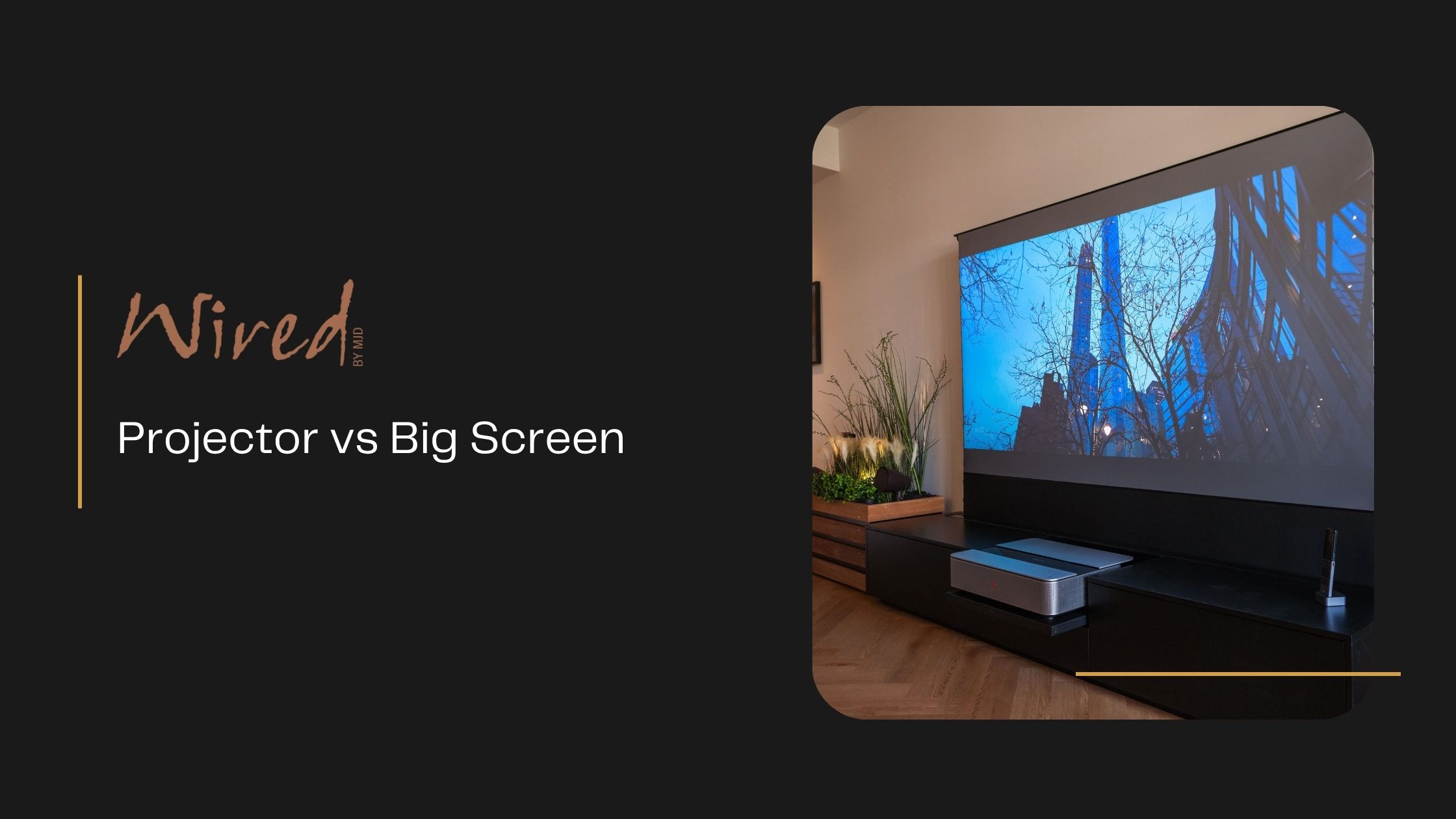
There’s still an ongoing debate when it comes to home cinema: projector or large-format display. Both have come a long way, and the right choice really depends on how the space is going to be used. At Wired by MJD, this is something we walk clients through when designing a home cinema.
Projectors have traditionally been the go-to for large-screen viewing, mainly because they could deliver big images at a reasonable cost. That’s shifting now. Large-format displays, whether LED panel systems or big single-panel screens, are catching up in size, and in some cases landing at a lower price point than a projector with equivalent brightness. Getting that level of brightness from a reflected light source is genuinely harder to engineer, which is part of why displays are closing the gap.
When it comes to a dedicated home cinema, we’ll still default to projection. Here’s why.
Why We Default to Projection in a Dedicated Cinema
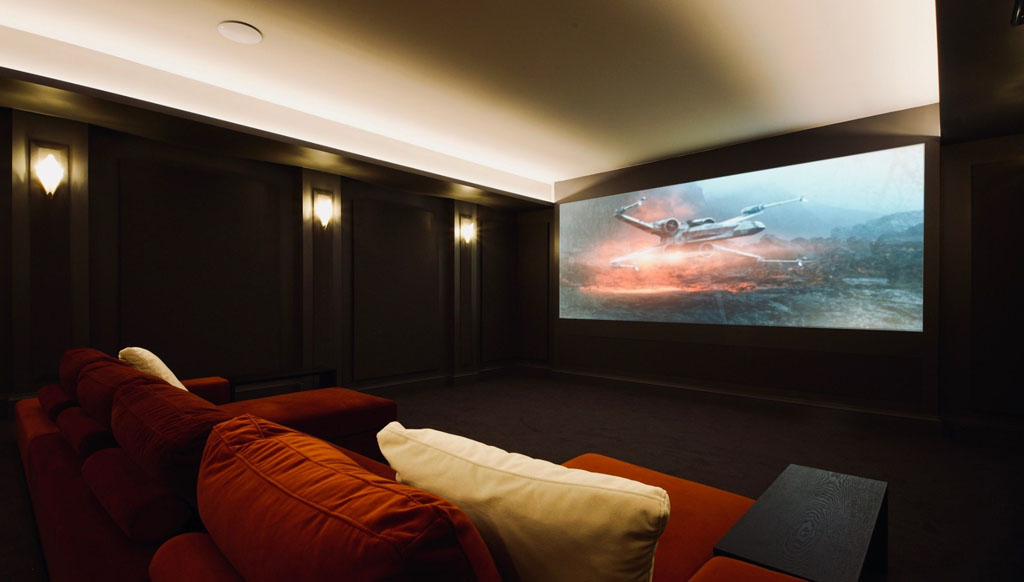
A woven or micro-perforated screen lets sound pass through the image itself. The better the screen, the less impact there is on audio performance passing through it. That means we can position the front sound stage, left, centre and right speakers, along with subwoofers, directly behind the screen, where reflections caused by the screen surface can be controlled with a small amount of absorption treated behind it. This is exactly how commercial cinemas are built, and it gives the most accurate sound imaging available.
It also keeps the room visually clean, with no visible speakers at the front of the space, which is something we prioritise in every Wired by MJD home theatre design.
There’s also how the eye experiences the image itself. We’re more comfortable absorbing reflected light than light emitted directly at us, which makes a projected image noticeably less fatiguing over a long viewing session.
Heat and noise matter too. Every light source generates heat, and projectors are no exception, but they can be isolated, either installed outside the room entirely or housed in a sealed enclosure with the heat extracted. That keeps the room temperature down, which means the air conditioning isn’t working as hard to compensate, which in turn keeps airflow noise out of the listening experience.
Where Projection Falls Short
Projection isn’t without its trade-offs.
Positioning can be tricky. In some rooms, concealing the projector or building a proper enclosure adds real cost to the build, particularly if the room wasn’t designed around it from the start.
Positioning can be tricky, and concealing the projector or building an enclosure can add cost.
Black levels are a genuine limitation. Black is the absence of light, and a projector can’t project an absence of anything, it can only project onto a surface. That means the areas of an image meant to be black will never be completely black. High-contrast screens help, but they don’t fully solve the problem, and in some cases they introduce other issues of their own.
Aspect ratios need more thought as well. A display can simply switch off the pixels it doesn’t need to create clean black bars. A projector can’t project black, so it can’t do the same trick. Done properly, this means screen masking, motorised panels that physically frame the active image area. It’s effective and it’s the same principle used in commercial cinemas, but it does add to the budget.
Where a Large-Format Display Makes Sense
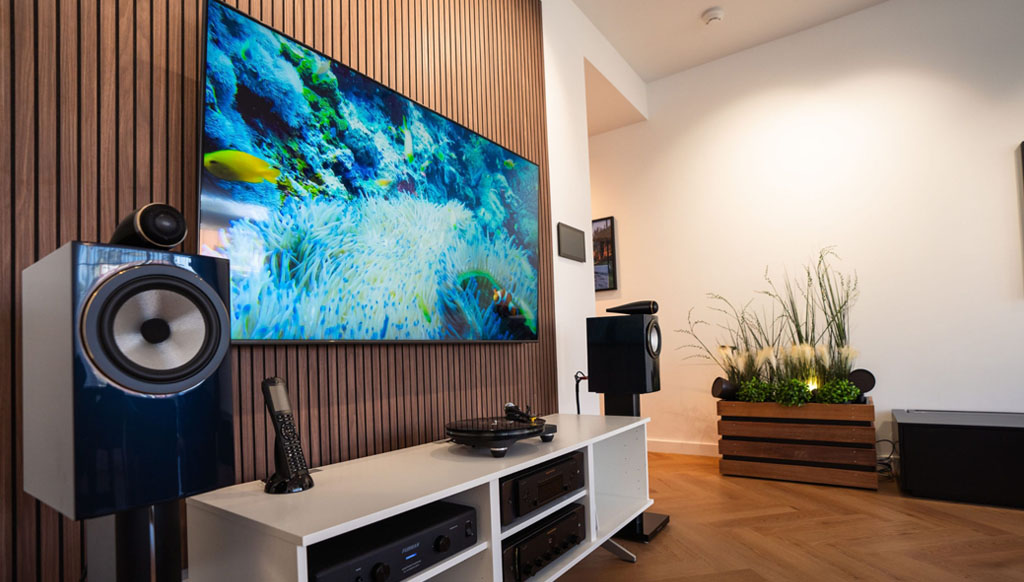
Large-format displays aren’t a compromise. In the right environment, they’re simply the better tool for the job.
Gaming setups are a good example. Where low latency matters more than ultimate image quality, and where the budget doesn’t stretch to high-end video processing, a display is often the smarter choice.
The same goes for media rooms that aren’t fully light-controlled. If there’s ambient light in the space, a display’s higher brightness output performs more consistently without needing to over-spec the rest of the system to compensate.
The trade-off with a flat panel is speaker placement. You lose the ability to put speakers behind the image the way you can with an acoustically transparent screen, so the front sound stage has to be engineered around the panel instead of behind it.
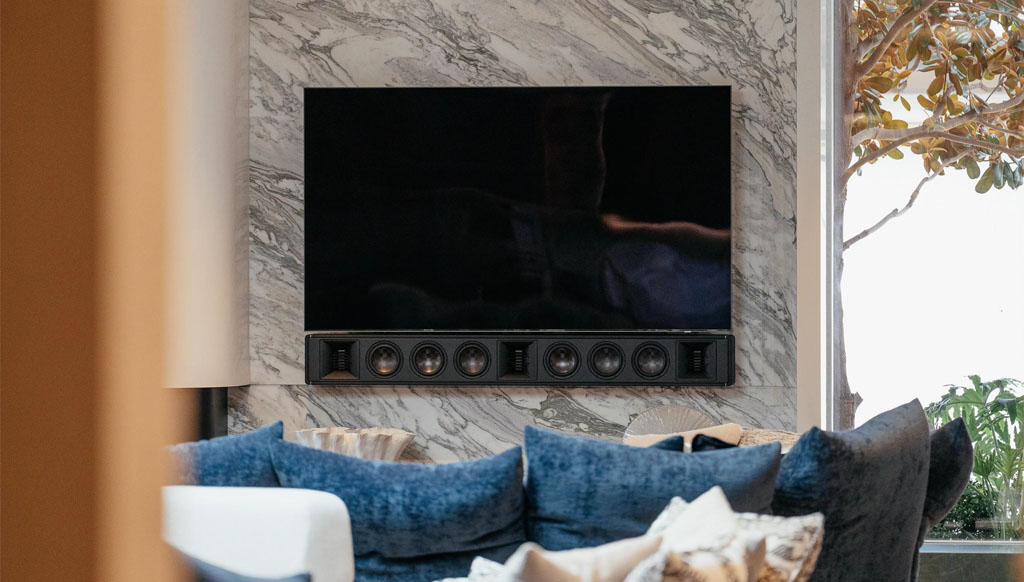
That’s not a reason to avoid displays, it’s just a different design problem, and technology like the MAG Theatron UNIBAR used in the House of Continuum project shows what’s possible when that problem is solved properly, with all three front channels delivered from a single slim enclosure mounted just 13mm from the wall.
Getting the Right Outcome for the Room
Our approach isn’t about pushing one technology over the other. It’s about designing the right system for the room and how it’s actually going to be used.
That said, if the goal is to recreate a genuine cinema experience at home, projection still feels like the most natural fit, and it’s where most of our dedicated cinema projects land. The cost of getting there properly, masking systems, enclosures, acoustic treatment behind the screen, is part of why cinema budgets vary as much as they do across the different tiers of a build.
Frequently Asked Questions
Is a projector or TV better for a home cinema?
For a dedicated home cinema, projection is generally the better fit. It allows speakers to be positioned behind the screen for accurate sound imaging and is less fatiguing over long viewing sessions. Large-format displays suit media rooms, gaming setups, or spaces with ambient light that can’t be fully controlled.
Why do projectors still struggle with black levels?
A projector produces an image by projecting light onto a surface, and it can’t project the absence of light. That means darker scenes will always carry some grey lift, even with a high-contrast screen. Large-format displays, particularly OLED panels, produce true black by switching off individual pixels entirely.
Can a projector be hidden in a home cinema?
Yes. Projectors can be installed in a ceiling recess, a dedicated projector room, or a sealed enclosure with proper ventilation. This is a common approach in our designs, both to keep the room visually clean and to manage the heat and noise a projector generates.
What is a screen masking system?
A screen masking system uses motorised black panels to frame the active image area, allowing a projector to correctly present different aspect ratios, such as widescreen 2.39:1, without leaving visible grey bars. It’s the same principle used in commercial cinemas.
Does choosing a display mean compromising on sound quality?
Not necessarily, but it does change the engineering. Without the option to place speakers behind the screen, the front sound stage has to be designed around the panel instead. With careful planning, a display-based system can still deliver excellent sound, it just takes a different approach to get there.
How does projector brightness compare to a large-format display?
Large-format displays generally produce higher peak brightness than a projector, especially in rooms with some ambient light. A projector relies on reflected light, so it depends heavily on a fully light-controlled room to deliver the same impact a display can produce more easily. In a dedicated, properly darkened cinema, this gap matters far less.
This one earns its place rather than padding the count — it directly answers a real comparison question, ties back to the reflected-light point already established earlier in the article, and gives AI/AEO systems a clean, standalone answer if someone searches specifically on brightness.
Not sure whether a projector or a large-format display is right for your space? Talk to the Wired by MJD team about your room and we’ll help you find the right fit.